Support Act or Minor Character
AktuellNow© Paolobon140 (2020) commons.wikimedia.org/wiki/File:La_Casa_degli_Omenoni_di_Milano_(circa_1565);_veduta_di_tre_quarti.jpg
Dance marathons were a popular form of entertainment and a lucrative business in the United States during the Great Depression. They promised participants money, hot meals, and perhaps a little fame. The record stood at several weeks of dancing, interrupted only by minimal breaks. After a few hours the pleasure turned into work for the participants, continuing until they were completely physically exhausted. Rather than moving across the floor, the couples swayed in place to the beat of the music, as if automated, supporting one another so as not to collapse in this cynical competition.
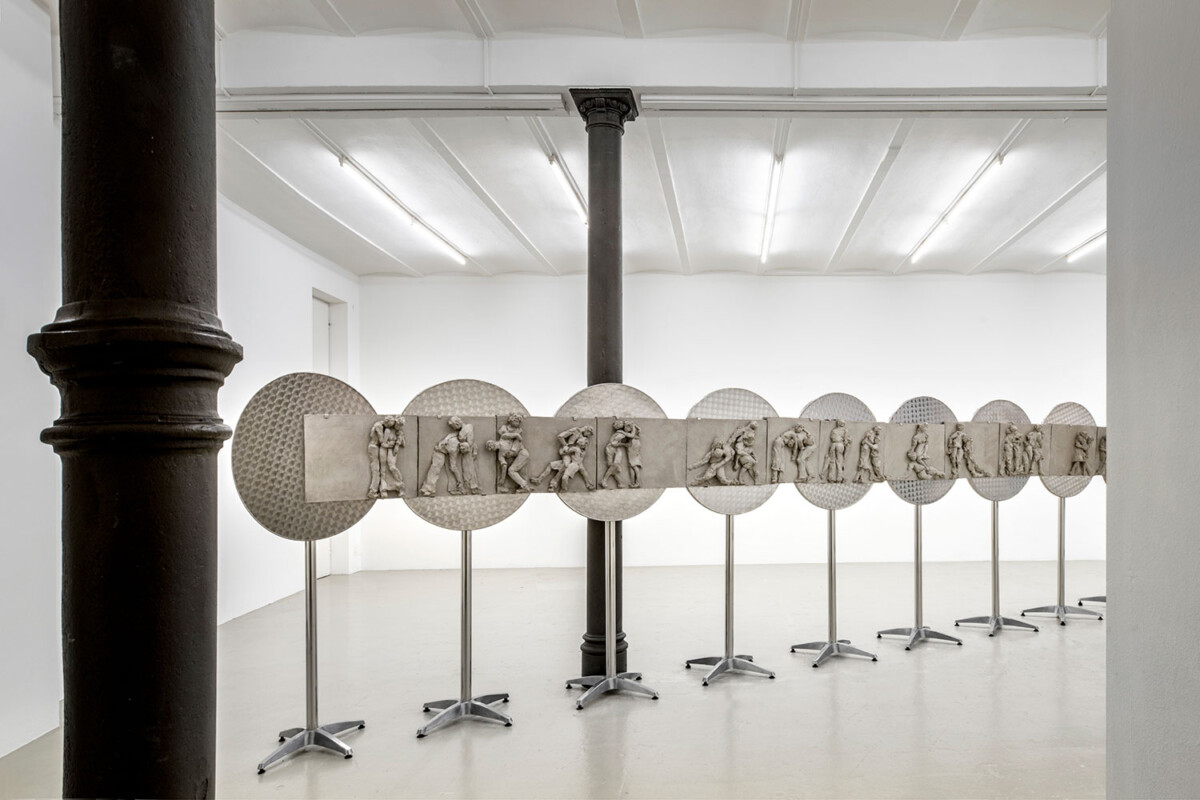
Nicole Wermers is interested in the human constellations of supporting and leaning that emerge during the final phase of a dance marathon—the sculptural ideal of contrapposto, understood as a harmonious relationship between the weight-bearing and free leg, translated into grotesquely distorted forms generated by the Fordist biopolitics of maximum self-exploitation. Dancing couples whose poses are documented in numerous historical photographs provide the visual material for the figures made of reinforced air-dried clay, as does Sydney Pollock’s film They Shoot Horses, Don’t They?. Originally produced for Lismore Castle Arts, Wermers has expanded the relief to include depictions of six additional dancing couples, thereby further emphasizing the aspect of collective physical dissolution. The fact that social class differences are reflected in dance marathons—and that they can even be regarded as precursors to today’s reality TV shows, with their transgressive performances by predominantly precarious participants—connects Marathon Dance Relief (extended) with reflections on social class and social space, Taylorist-optimized movement patterns, and generalized exhaustion as a diagnosis of an unbounded modernity.
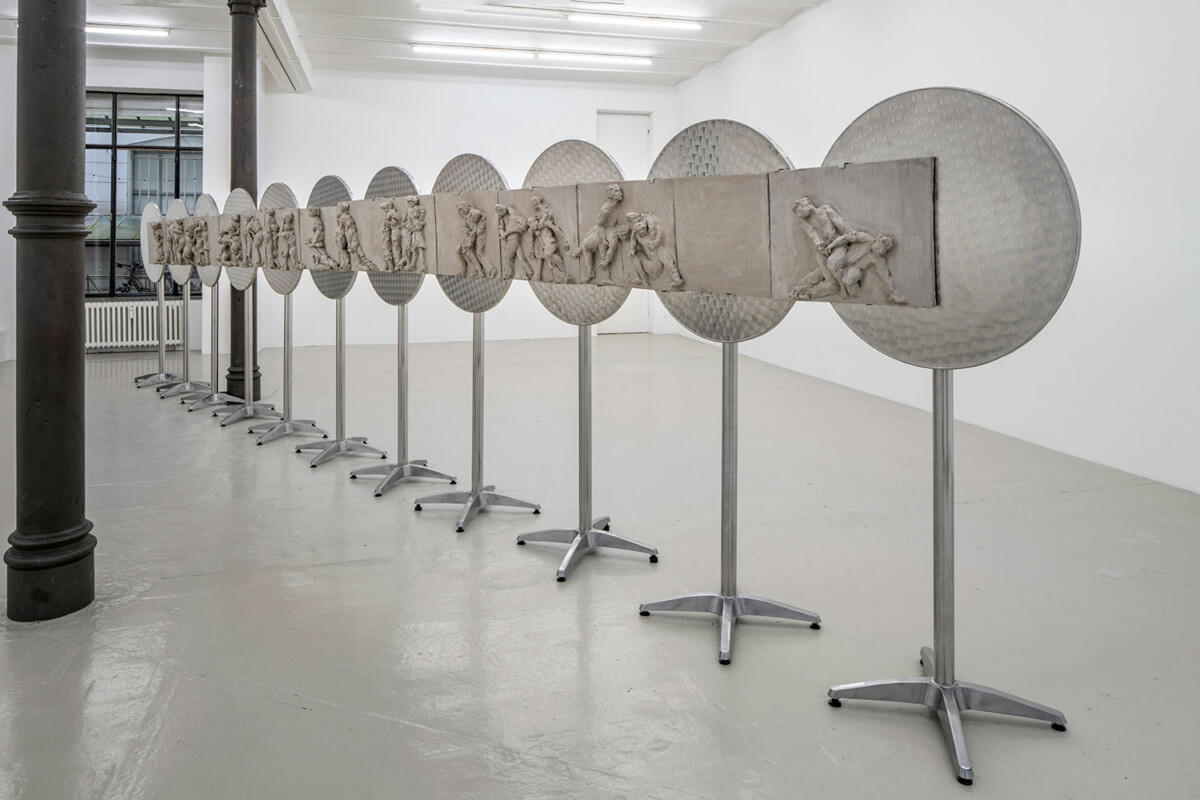
Now extending across more than fifteen panels, the relief deliberately translates images of staggering couples on the dance floor into the aesthetics of heroic depictions of workers in public space, as shaped by socialist buildings since the 1920s. Invisible labour—for that is precisely what the continuous dancing disguised as entertainment amounts to—appears here in the formal language historically associated with physically arduous work. The Marathon Dance Relief also draws on the tradition of the ancient frieze, with its dynamic sequence of interacting bodies at different points in time within an action. Interestingly, it was often women who supported their dance partners and hoisted them into an upright position until the very end. Their depiction introduces classical Pietà motifs into the compositions, emphasizing care as a form of labour coded as feminine. The body politics of invisible labour, a central theme for Wermers that she most recently addressed in her series Reclining Females, also appear in the figures, frozen in movement and seemingly pulled downward by the gravity of the material.
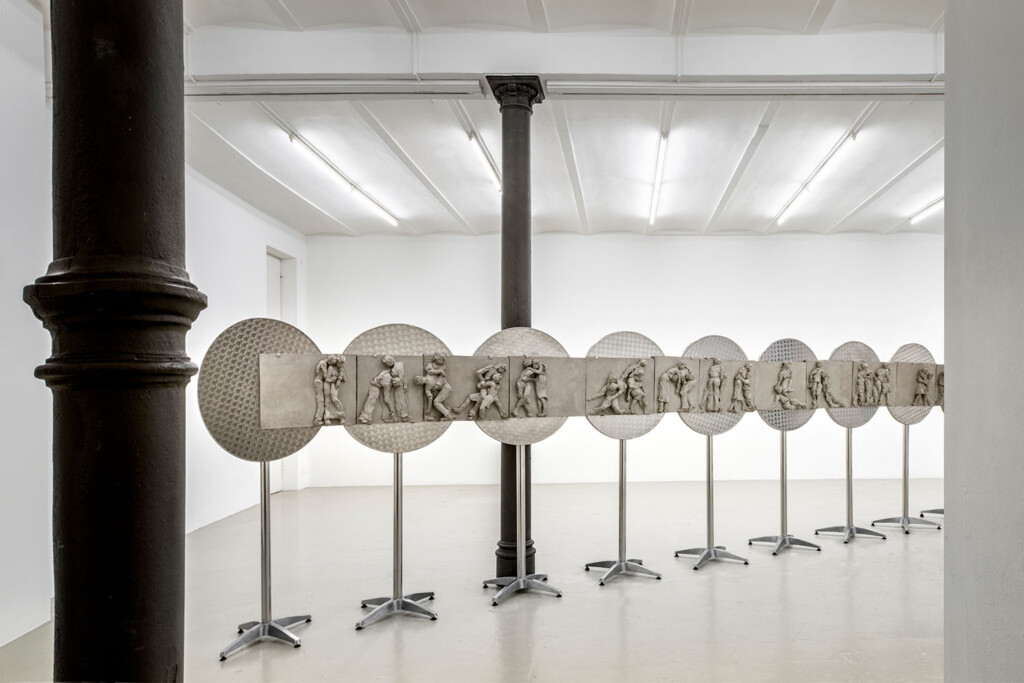
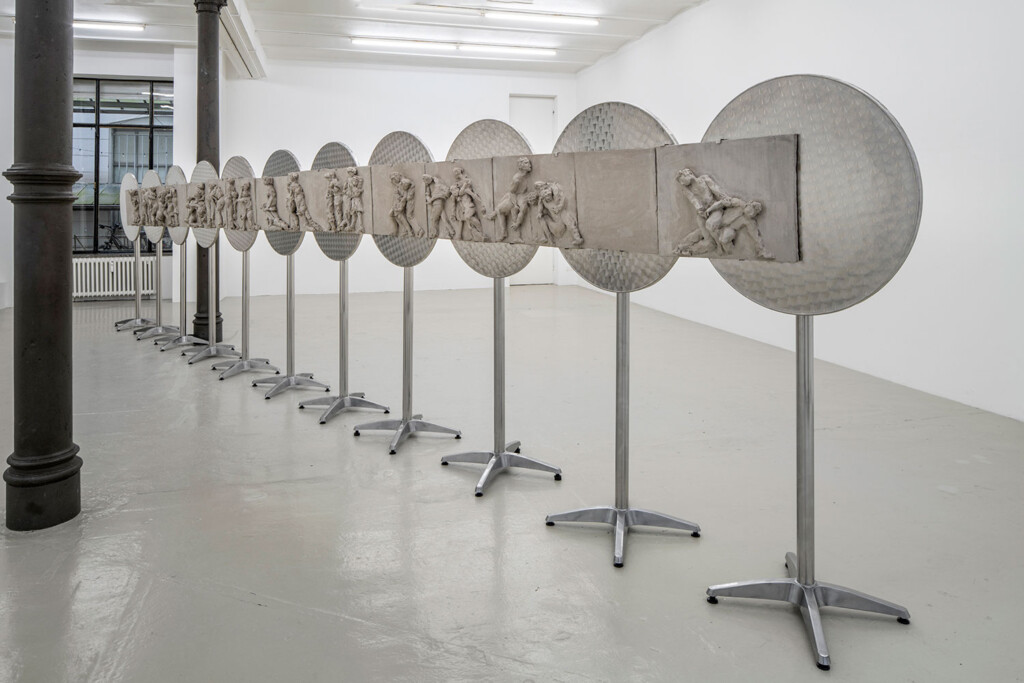
This frieze could adorn a building like a decorative band, but it is installed on modified café tables that have been folded upright. The linear sequence of the relief panels organizes the simultaneity of events on the dance floor into a succession reminiscent of the Fordist assembly line and its technical optimization of human labour. The folding tables function as a kind of space-defining element, creating an expanded working and activity area through their fold-out surfaces. The café as a zone of negotiation between public and private is also evoked by the presentation of the metallic, reflective tables, which mirror their surroundings. Scenes from Pina Bausch’s choreography Café Müller (1985) likewise form part of the associative horizon of the Marathon Dance Relief: in the piece, dancers repeatedly collide with café tables as if sleepwalking, trapped in a logic of movement that appears to be determined by external structures.
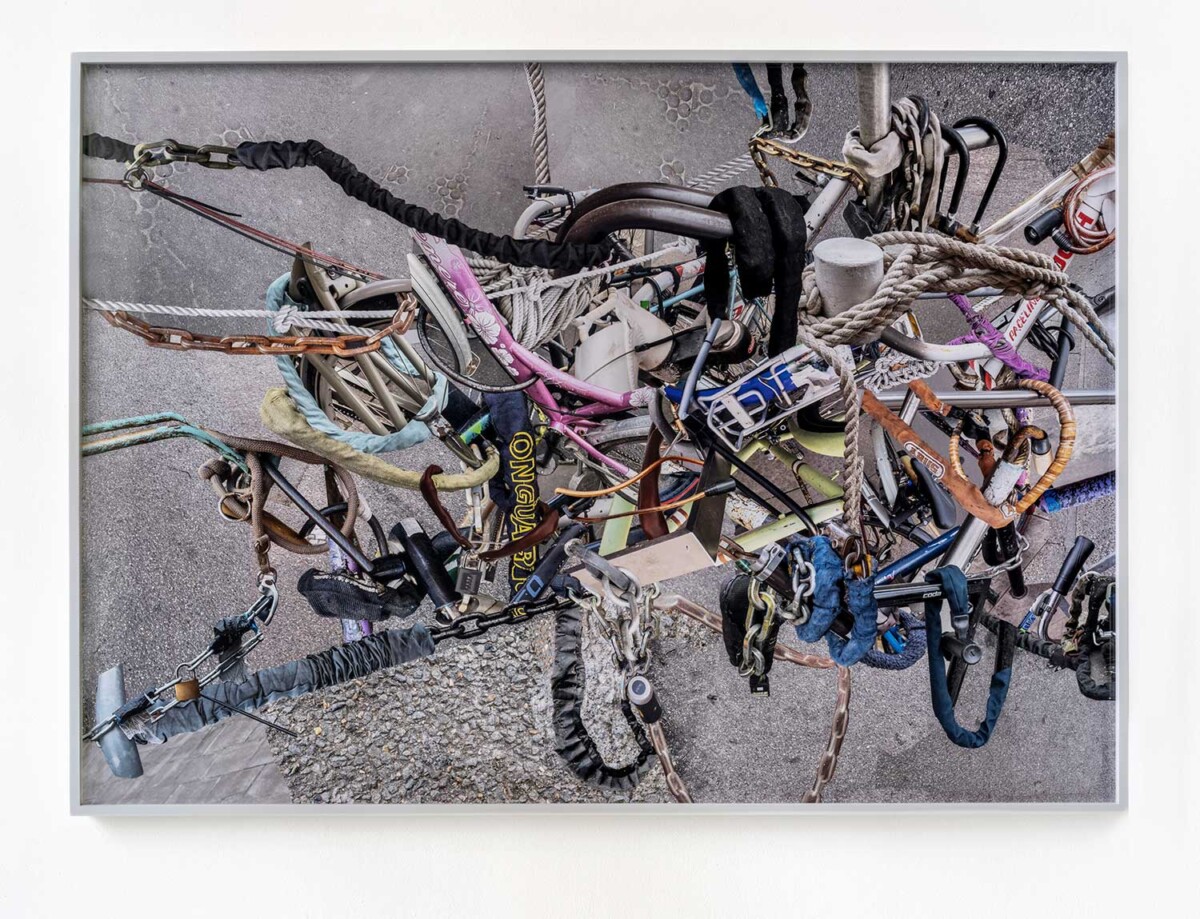
Shifted into the object-like routines of the present, this affective as well as economic search for support continues in the digital collages Attachments (Digest) #2–4 (2026), which depict a multitude of interwoven bicycle locks and ropes. The ropes are taken from Wermers’ photographs of houseboats moored along London’s Regent’s Canal, which she walks along every day on her way to the studio. In their accumulation of fastening and mooring, the ropes, together with the bicycle chains, recall umbilical cords, but also Eva Hesse’s rope sculptures from the late 1960s, with their complex arrangements that resist any categorization and in which the inherent properties of the material determined the final form. This tension between order and chaos, control and letting go, reappears in the locks, translated into a logic of everyday life. At the same time, locking up a bicycle is a micro-action that marks ownership and effectively privatizes a place in public space.
Drawings of delivery drivers taking a break, meanwhile, form the motif of a textile pattern decorating the cover of a foam cushion. Together with two cabinet units in the gallery space—rendered immovable by the repeated layers of paint applied to the floor—they create something resembling a changing mat: the Collective Baby Changing Station. Wermers had already incorporated changing units in public spaces into her Moodboards, transforming them into hybrid objects somewhere between an altar and a worktable. The resting drivers, whom one normally knows only in constant motion, use their distinctive cubic backpacks as objects to lean against. Subjected to the conditions of the gig economy, they form a supporting structure of modern working life, which functions only by continually outsourcing precarious forms of employment. To Wermers, the delivery drivers appear like Atlases—the figures who, instead of a column, carry the entablature of a building. Here, too, classical formal language is translated into the present and charged with reflections on social declassification, repressive economic structures, and the role of the human body within them.
Nicole Wermers Marathon Dance Relief (extended) 2025/2026 Reinforced and air-dried clay, modified bistro tables, fixings Dimensions variabel
Exhibition view Nicole Wermers Support Act or Minor Character, Produzentengalerie Hamburg, 2026
Nicole Wermers Marathon Dance Relief (extended) 2025/2026 Reinforced and air-dried clay, modified bistro tables, fixings Dimensions variabel
Exhibition view Nicole Wermers Support Act or Minor Character, Produzentengalerie Hamburg, 2026
Nicole Wermers Collective Baby Changing Station 2026 Printed water-repellent fabric, foam Dimensions variable
Exhibition view Nicole Wermers Support Act or Minor Character, Produzentengalerie Hamburg, 2026
Nicole Wermers Attachments (Digest) #2 2026 C-Print on Dibond, (digital collage) 104 x 144 cm framed 1/1 plus 1 AP
Nicole Wermers Attachments (Digest) #3 2026 C-Print on Dibond, (digital collage) 104 x 144 cm framed 1/1 plus 1 AP
Nicole Wermers Attachments (Digest) #4 2026 C-Print on Dibond, (digital collage) 104 x 144 cm framed 1/1 plus 1 AP
Nicole Wermers Collective Baby Changing Station 2026 Printed water-repellent fabric, foam Dimensions variable
Exhibition view Nicole Wermers Support Act or Minor Character, Produzentengalerie Hamburg, 2026
Nicole Wermers Collective Baby Changing Station 2026 Printed water-repellent fabric, foam Dimensions variable
Exhibition view Nicole Wermers Support Act or Minor Character, Produzentengalerie Hamburg, 2026
Nicole Wermers Marathon Dance Relief (extended) 2025/2026 Reinforced and air-dried clay, modified bistro tables, fixings Dimensions variabel
Exhibition view Nicole Wermers Support Act or Minor Character, Produzentengalerie Hamburg, 2026