Horizontal Fold
AktuellNowBild 1–5: Courtesy Barbara Wien
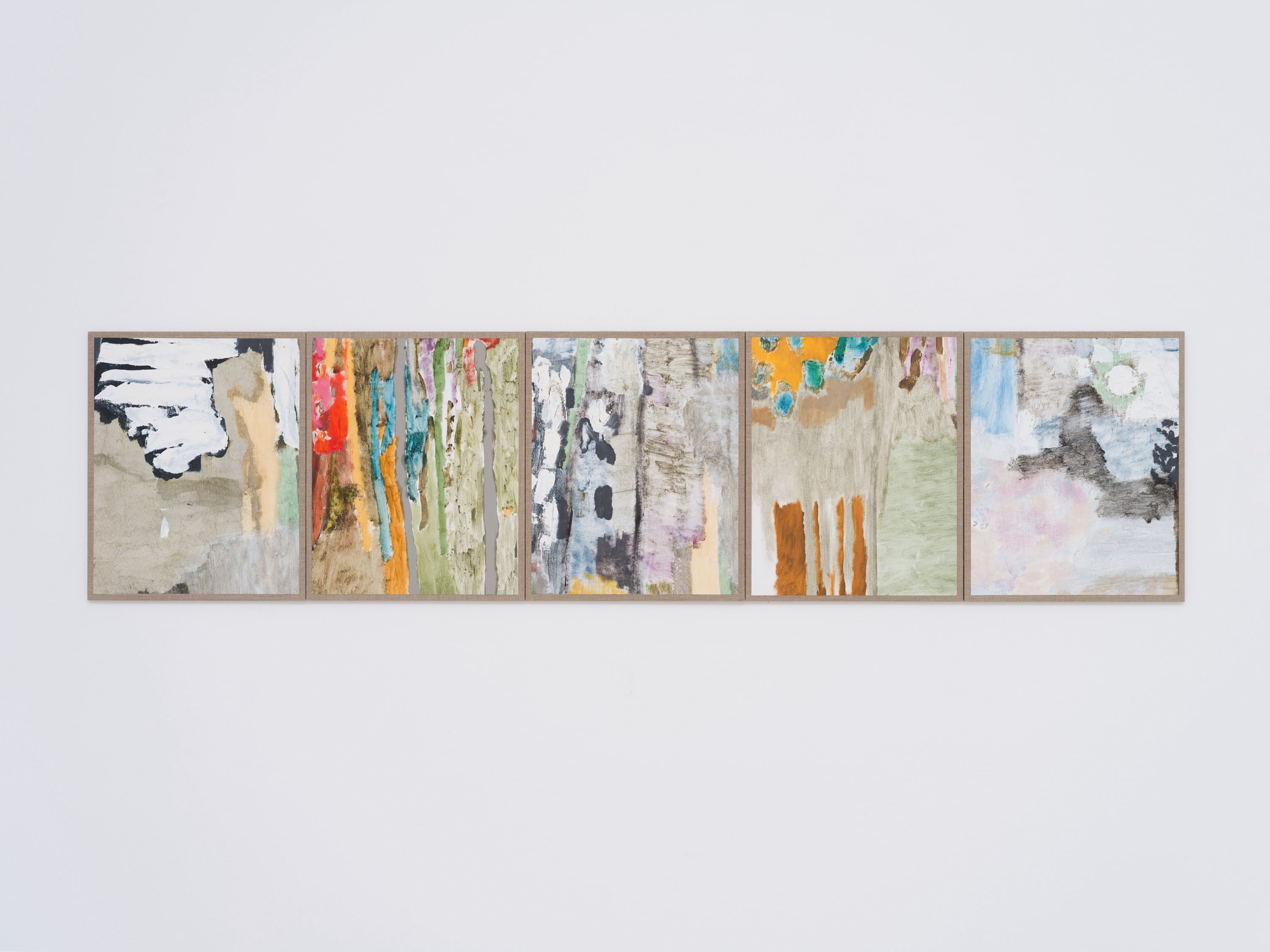
Bild 6: Halla, 2026 Mixed media on canvas, 5 paintings, overall: 50 × 208 cm © Andreas Eriksson / VG Bild-Kunst, Bonn
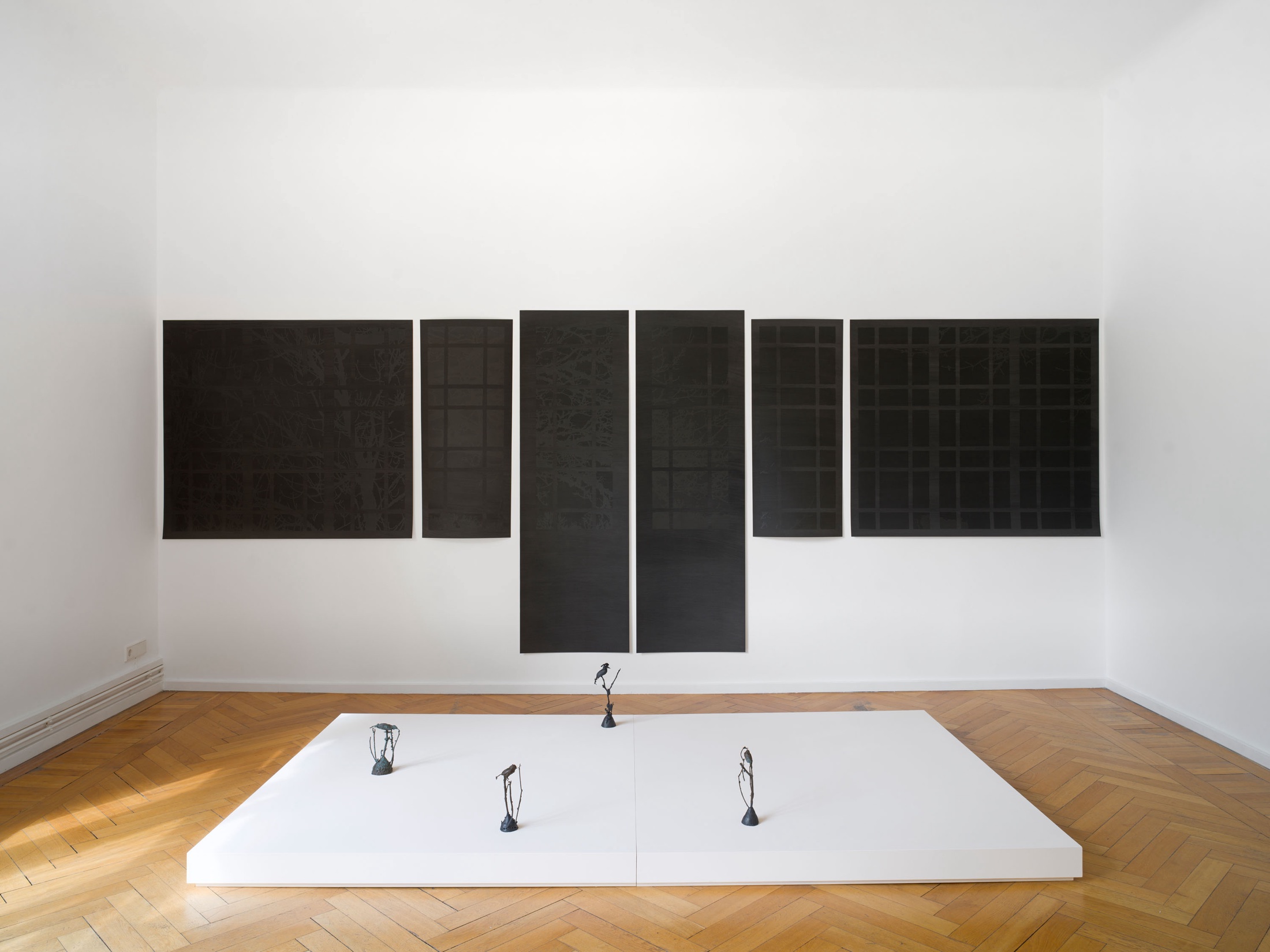
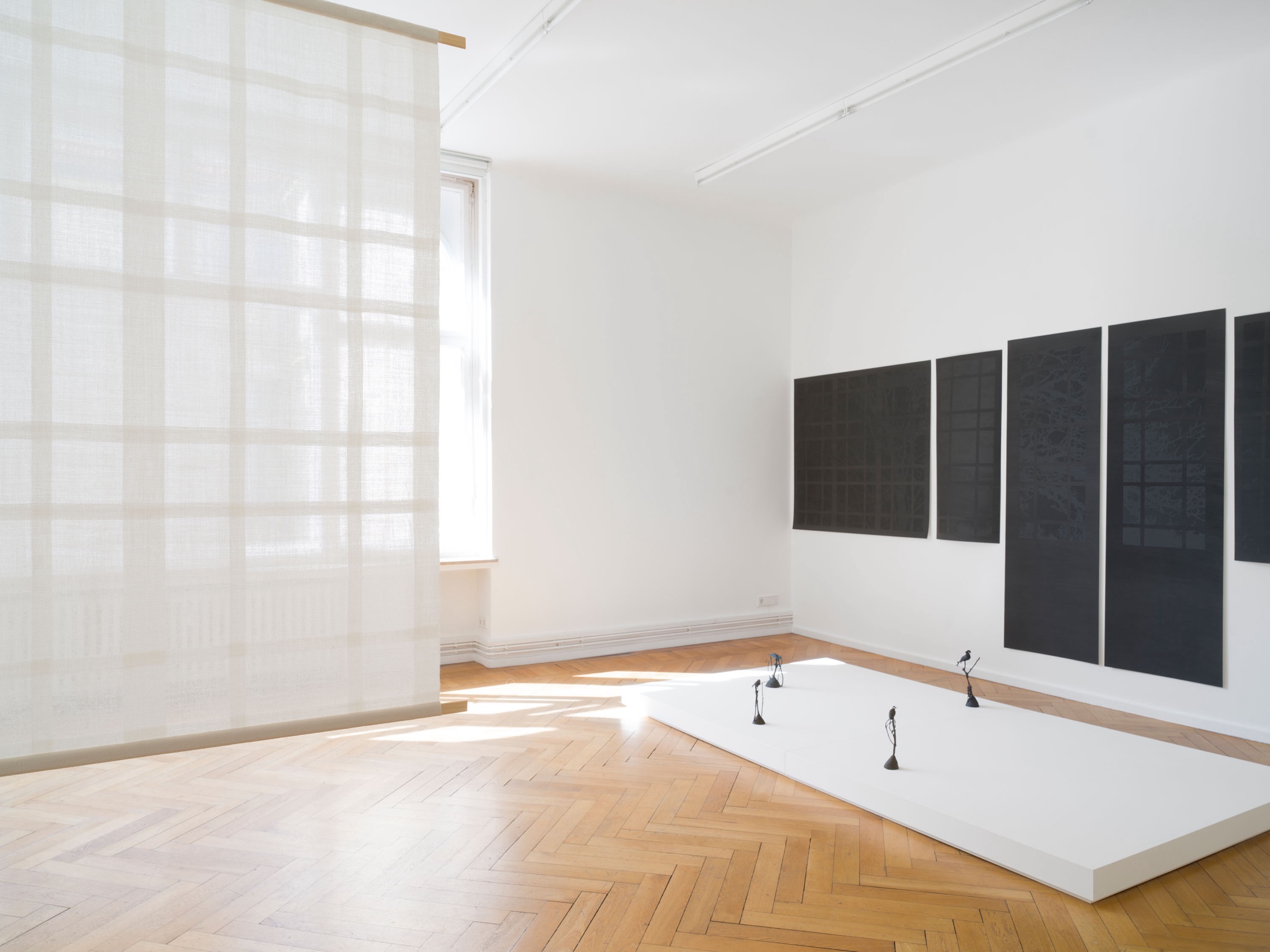
Barbara Wien is pleased to present Horizontal Fold, Andreas Eriksson’s first exhibition with the gallery, realized in cooperation with neugerriemschneider, Berlin. Opening concurrently at neugerriemschneider is painting the path, a dialogue between the Swedish artist Andreas Eriksson and the Korean artist Kim Chong Hak. Horizontal Fold is a substantial presentation of Eriksson’s practice, bringing together recent and newly produced works in painting, photography, weaving and sculpture, alongside more than two decades of the artist’s publications. In Andreas Eriksson’s work, a painting may begin with the behaviour of the material, a watercolour may become a shadow, a window a weaving, a landscape a photograph and a painting, an exhibition a book. “It’s like I’m talking about the same thing over and over again in different ways.”* In the south room of the gallery, Eriksson brings part of his home and studio in Medelplana, Sweden, into the exhibition. A translucent veranda, woven in wool damask, hangs in the room. It forms part of Huset lutar men gardinerna hänger rakt (2024) – The House Leans but the Curtains Hang Straight – a major, 25-part installation that reconstructs the windows and doors of Eriksson’s house. Its title borrows a phrase from Thomas Bernhard’s Monologe auf Mallorca (1981). The complete installation was presented at Lillehammer Kunstmuseum in Norway in 2024. Veranda (2026), a new six-part screenprint at a scale of 1:1, returns to the same architecture. Built through successive layers of highly diluted oil colour, its dark surface holds the windows of the veranda, branches and the landscape beyond them. Architecture, image, interior and exterior begin to overlap.
Asked during our conversation in April 2026 about bringing his studio into the gallery, Eriksson replied: “What I am bringing here is absolutely my home. I mean, what else could I bring? I can’t see anything else. What should I otherwise bring? It’s my surroundings.”
“In one way it’s a landscape and portrait of my surroundings, but it’s also a landscape and a portrait of myself somehow.”
In the woven work, white threads and the transparency of the textile evoke looking through a window onto snow.
“It also feels a little bit like a dream, like you dreamed the house. It’s like a ghost of the house.” Nearby stand bronze sculptures from Eriksson’s ongoing series Content is a Glimpse (since 2003). The series began with birds found dead after colliding with the windows of his studio in Medelplana. Reflections of the surrounding landscape had appeared to the birds as an opening into space. Eriksson preserved and cast their bodies in bronze. He has described them elsewhere as having made the mistake of believing in an illusion – the mirroring of the landscape in glass. The bird trusts what it sees.
In our conversation, Eriksson recalled an observation by Willam de Kooning: a stick entering water appears visually broken by refraction, even while we know the stick remains intact.
“You can’t even speak about illusion anymore; it’s just a way of looking.”
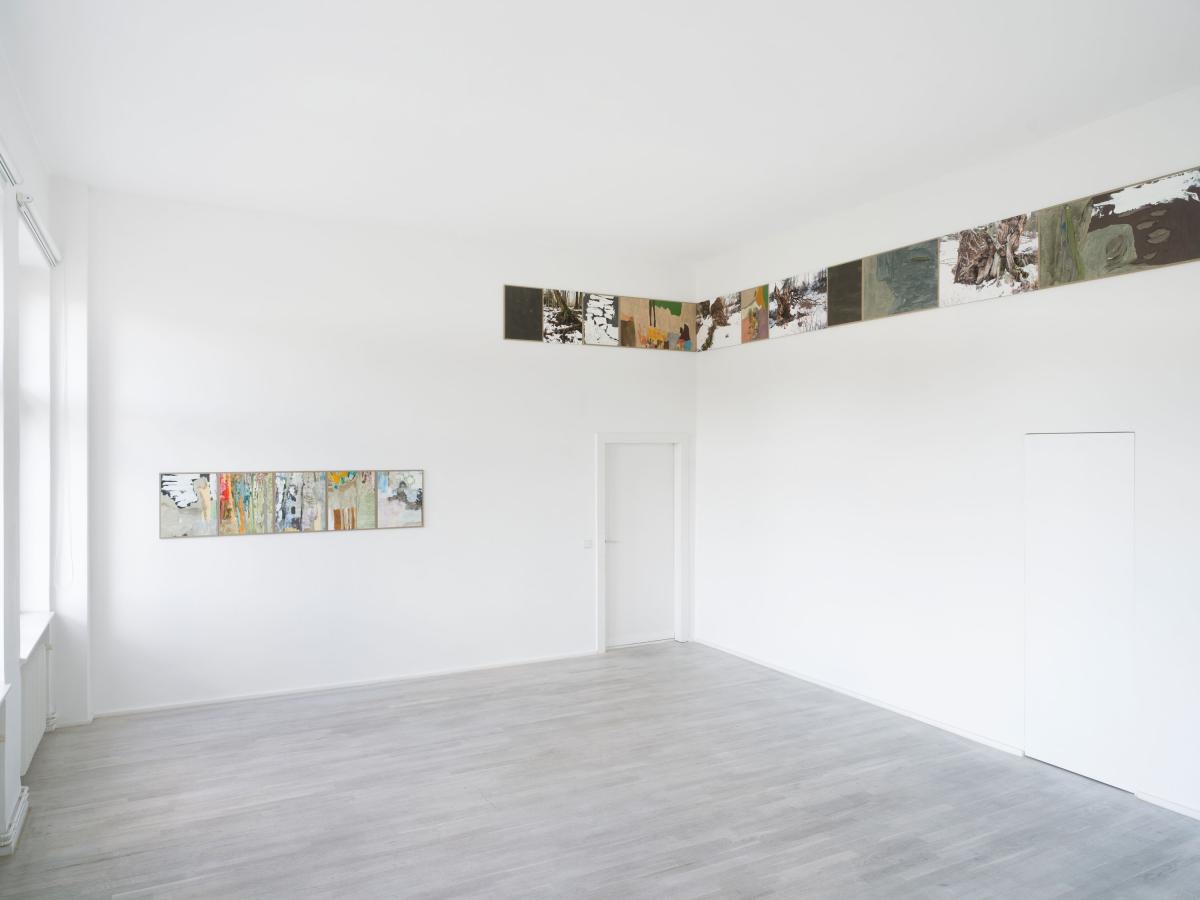
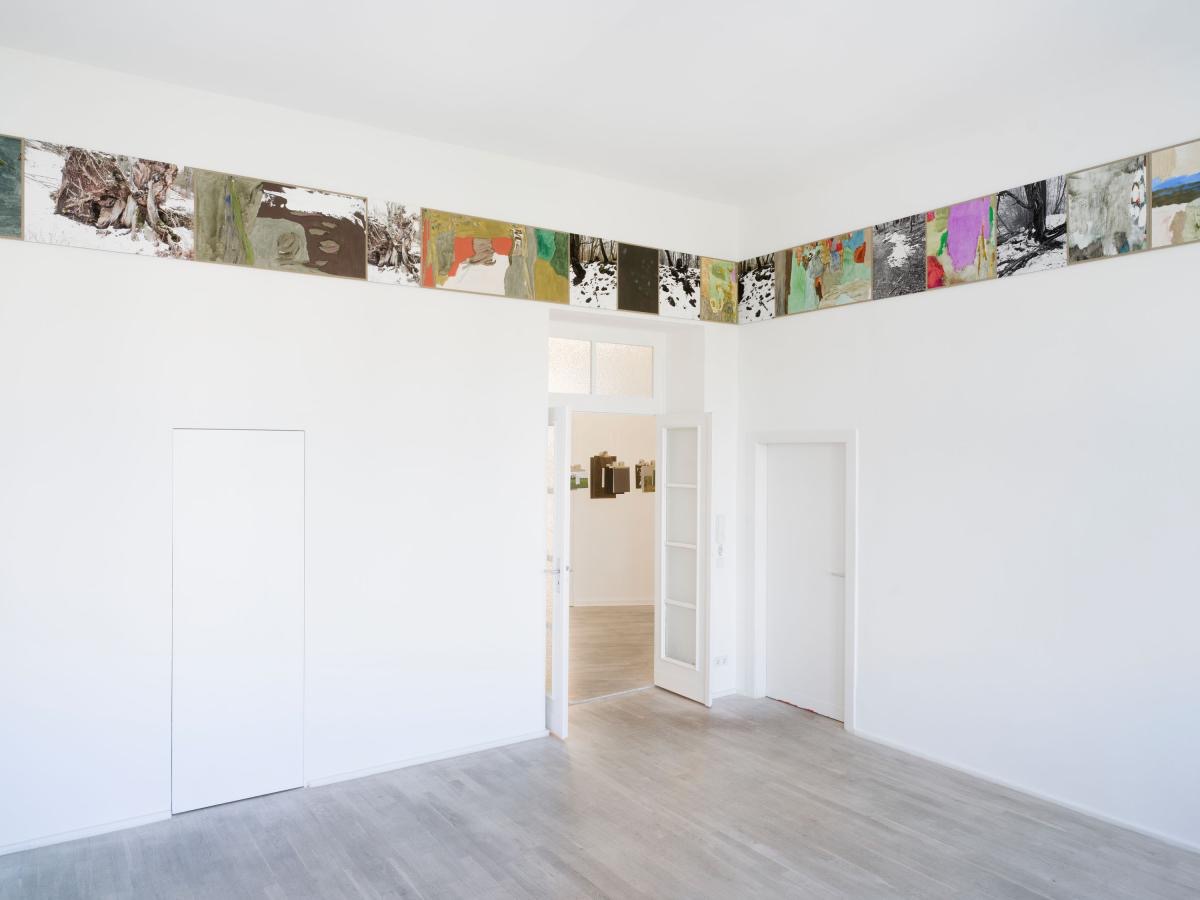
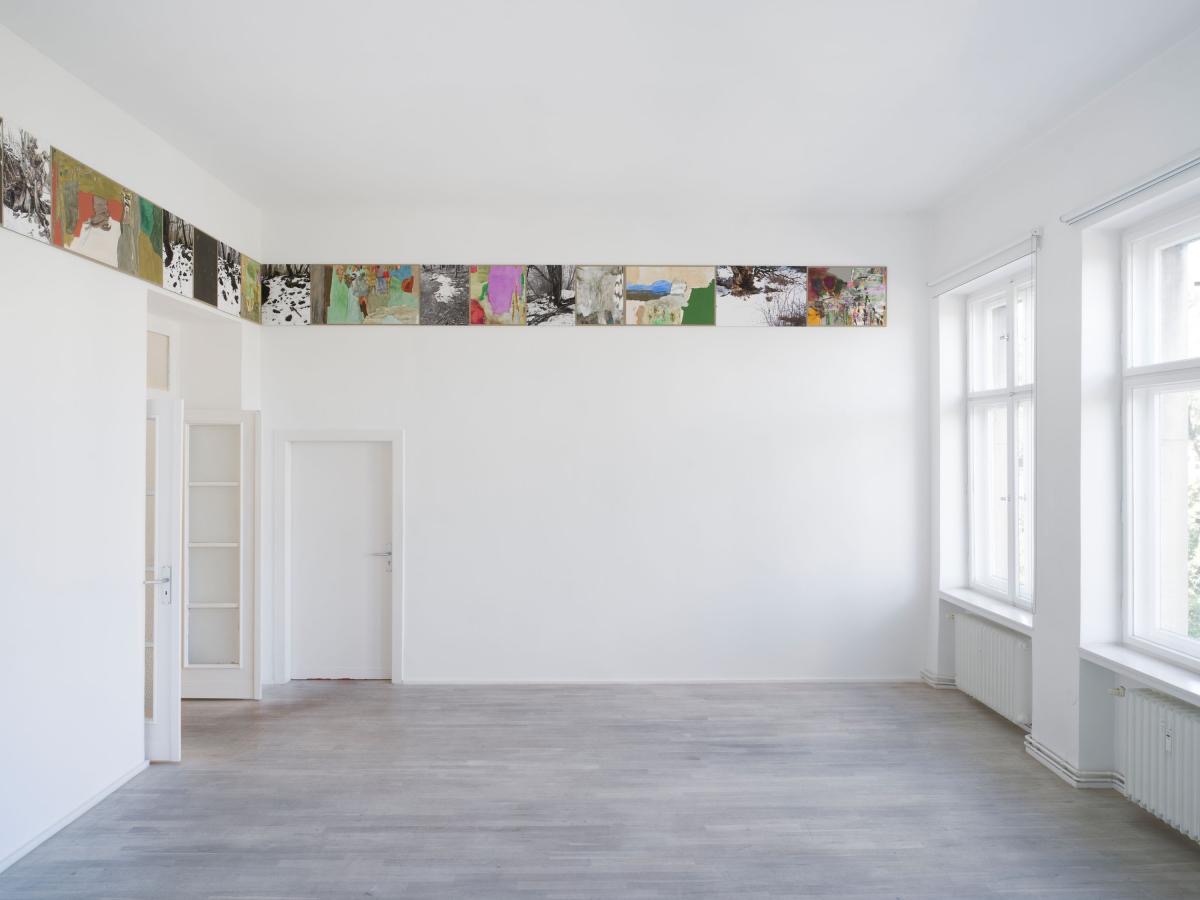
Conceived for the north room of the gallery, Walking the dog (2026) is a frieze of approximately 16 meters comprising 26 parts: 15 paintings and eleven photographs made from the winter landscape around Medelplana. Painting and photography alternate without one serving as a key to the other. Eriksson has experimented with the form of the frieze since the 1990s and describes being particularly interested in “the things that happen between photos and paintings.” “When things look totally different, they end up in a similar way.”
“I love the connections between the photos and the paintings.”
“What I try to do is to discover the painting while I’m doing it.”
“Then I just listen and listen and listen. And then suddenly it’s there. It has a body.”
Walking the Dog faces the gallery windows overlooking Schöneberger Ufer. Eriksson was drawn to the correspondence of his frieze with the window view and the Landwehrkanal outside while conceiving the exhibition: “now it’s a good moment to show it because I like the river outside, so it’s in dialogue with that somehow.” The winter landscape of Medelplana enters the room overlooking the water in Berlin, while outside the gallery the seasons shift from late summer through autumn and into winter. Eriksson says of the images in the frieze:
“It’s my outside, maybe from my house.”
“So it’s the ghost again, somehow.”
For approximately 25 years, Eriksson has walked almost every day along the same path around his home in Medelplana. Usually he walks it twice a day. It takes around 27 minutes.
“If someone one time goes through my archive with photos, they will see the same, same path all the time, but the trees are bigger.”
“Now I have this personal relationship to every stone and every branch there, every tree.”
“I think it also relates to art very much, how you relate to things.”
“Ambitious art is the worst, I think.”
“I don’t have a mission. I don’t want to tell anyone anything.”
“It’s just about sharing my fun in the studio and showing somehow maybe how it is to be a human being.”
“I put a lot of trust in nature.”
Walks around Medelplana and through the nature reserve of Halla also inform Halla (2026), a group of five paintings.
In the foyer of the gallery, more than two decades of Eriksson’s publications hang from the ceiling, forming a floating library.
Books have accompanied the artist’s practice since its beginnings, operating not simply as documentation but as another space in which works are made and encountered. “I did the exhibitions in the book somehow,” Eriksson says. A publication might begin with the dimensions of a group of paintings, a reproduction, a sequence, a fold:
“It’s the same as when I do the paintings. It starts with just how you can fold a book, or how can you, if I’ve done a series of paintings, (…) think about the paintings and how would they look in this size.” During a studio visit in Medelplana, looking at the sheer number of publications and publishing projects, Eriksson joked that he was keeping printers in shape. To mark Horizontal Fold and Eriksson’s first exhibition with Barbara Wien, the artist will publish a leporello edition developed from Walking the Dog. Folding his work once again into the space of a book.
Text: Alberto Morreo