Resurfacing Iris
BaldSoonCourtesy Alexander Levy
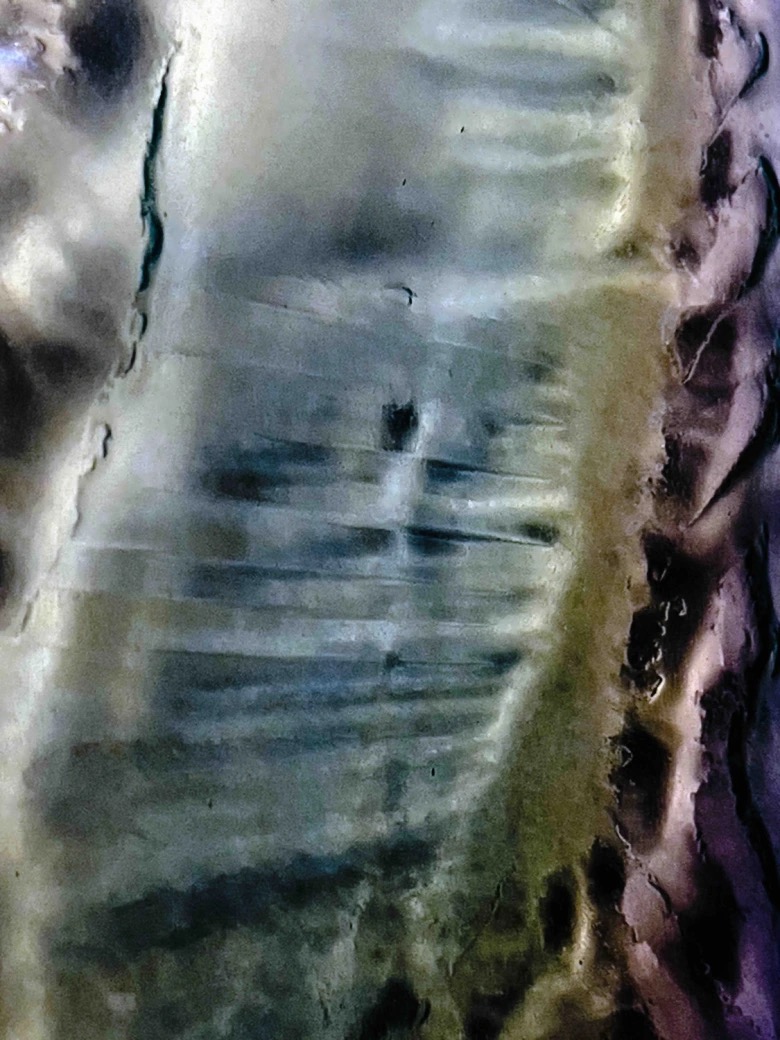
I had previously written a fictional narrative presenting Vicky Uslé’s (Santander, Cantabria, 1981) vitreous and photographic work as an investigation into light, perception, matter, and its transformation. In that text, the figure of a guru functioned as an interpretive mediator who, drawing on philosophical, theological, mythological, and historical references, proposed that the works be understood as processes in which light, the properties of the material, the passage of time, and the artist’s intervention all participate in the generation of forms, traces, reliefs, and unrepeatable configurations. The guru’s eventual transformation into a saline puddle takes this reflection to its ultimate consequences: the subject who had set out to explain the work ends up dissolving into the very process of material transformation he had been describing. Something similar occurs in Resurfacing Iris, Vicky Uslé’s current solo exhibition at alexander levy, insofar as it continues the same body of work. Yet, as I examined the new works, another series of thoughts began to take shape.
Starting with gravity, as evoked by the sculptural presence of these new works, their play of light and shadow, and their colors, I find myself thinking of the theory proposed by João Magueijo and Lee Smolin known as rainbow gravity. According to this theory, the metric of spacetime depends on the energy of the particle probing it: the geometry a photon “sees” varies with its energy. Each color, so to speak, would inhabit a space of its own. What I borrow from this theory is the suspicion that light does not pass through the same thing in the same way, depending on what it is. Glass, meanwhile, does something related without requiring any particularly audacious hypotheses. It is a dispersive medium, with a refractive index that depends on wavelength, such that each color travels through a different effective geometry. This is what we call a prism, and the prism comes with a long history of grievances. Keats lamented that Newton had destroyed the poetry of the rainbow by reducing it to prismatic colors, and used the verb unweave. Goethe devoted part of his theory of color to arguing against Newton. Physicists never accepted Goethe’s theory, although his attention to the perception of color proved influential. Of Goethe, in the context of this exhibition, one sentence matters to us: the one that asserts our right to marvel at the manifestations of color and, if possible, to intuit its secrets. Uslé thus occupies the uncomfortable yet fertile position of someone who does not want the magnifying glass to kill the mystery, while knowing, at the same time, that mystery has a structure. This exhibition attempts to hold both things in view.